Nailer safety warnings
- Always assume that the nailer contains fasteners. Careless handling of the nailer may result in unexpected firing of fasteners and personal injury.
- Disconnect the nailer from the power source when loading and unloading fasteners, making adjustments or changing accessories. The nailer may be accidentally activated if it is connected to the power source, which may result in personal injury.
- Be careful when handling fasteners, especially when loading and unloading. The fasteners have sharp points which may result in personal injury.
- Do not point the nailer towards yourself or anyone nearby. Unexpected triggering will discharge a fastener, which may result in personal injury.
- Keep fingers away from trigger when not operating the nailer and when moving from one operating position to another. Unexpected triggering will discharge a fastener, which may result in personal injury.
- Hold the nailer by insulated gripping surfaces, when performing an operation where the fastener may contact hidden wiring. A fastener contacting a "live" wire may make exposed metal parts of the nailer "live" and could give the operator an electric shock.
- Hold the nailer with a firm grasp during operation. Uncontrolled recoil of the nailer may result in unintended activation, which may result in personal injury.
- Keep all body parts such as hands and legs, etc. away from the firing direction of the nailer. The fastener may penetrate the workpiece as well as any object behind it, which may result in personal injury.
- When using the nailer, keep all body parts such as hands and legs, etc. away from the area where the fastener is driven into the workpiece. The fastener could deflect and exit the workpiece, which may result in personal injury.
- Do not actuate the nailer unless the nailer is placed firmly against the workpiece. If the nailer is not in contact with the workpiece, the fastener may be deflected away from the workpiece, which may result in personal injury.
Additional Safety Information for GNB 18V‑40:
- When fastening electrical cables, make sure the cables are not energized. Hold the nailer only by insulated gripping surfaces. Use only fasteners designed for electrical cable installations. Inspect that the fastener has not damaged the insulation of the electrical cables. A fastener that damages the insulation of electric cables can lead to electric shock and fire hazards.
Additional safety information for GNB 18V‑38:
- Do not use this nailer for fastening electrical cables. It is not designed for electric cable installation and may damage the insulation of electric cables, thereby causing electric shock or fire hazards.
- Disconnect the nailer from the power source if a fastener jams in the nailer. While removing a jammed fastener, the nailer may be accidentally activated if it is connected to the power source, which may result in personal injury.
- Use caution while removing a jammed fastener. The mechanism may be under compression and the fastener may be forcefully discharged, which may result in personal injury.
- Use suitable detectors to determine if there are hidden supply lines or contact the local utility company for assistance. Contact with electric cables can cause fire and electric shock. Damaging gas lines can lead to explosion. Breaking water pipes causes property damage.
- In case of damage and improper use of the battery, vapours may be emitted. The battery can set alight or explode. Ensure the area is well ventilated and seek medical attention should you experience any adverse effects. The vapours may irritate the respiratory system.
- Do not modify or open the battery. There is a risk of short-circuiting.
- The battery can be damaged by pointed objects such as nails or screwdrivers or by force applied externally. An internal short circuit may occur, causing the battery to burn, smoke, explode or overheat.
- Only use the battery in the manufacturer's products. This is the only way in which you can protect the battery against dangerous overload.
Protect the rechargeable battery against heat, e.g. including prolonged sun exposure, fire, water, and moisture. There is a risk of explosion and short circuit.


Always wear hearing protection and safety goggles when using the power tool.
- Do not use the power tool and the nails on very soft materials (e.g. wood, lightweight construction materials). The nails may penetrate the substrate and may cause injury.
- Do not use the power tool and the nails on very hard materials (e.g. high-strength steel, very hard natural stone) or on types of concrete with high compressive strength or aggregate with high compressive strength. If the material is too hard, the nail may ricochet, break and escape and may hit you or other persons and may cause injuries.
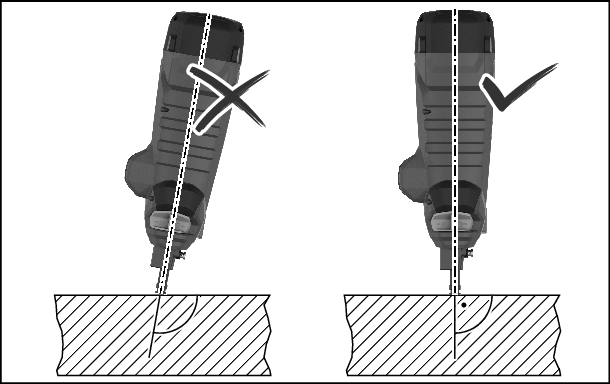
- Never hold the power tool when it is at an acute angle to the substrate. The power tool must be perpendicular to the substrate. There must be no contamination on the substrate.
- Do not deactivate or remove the contact element. The contact element is a safety mechanism to reduce the risk of unintentional triggering. Deactivating this component may lead to unintentional triggering.
- Only use the power tool if the contact element is functioning correctly. If the contact element is defective, the power tool may trigger unexpectedly.
- Always fill the magazine of the power tool with nails first before you insert the battery. This reduces the risk of accidentally discharging a nail and injuring yourself or other people.
- Never discharge nails in the vicinity of flammable materials. When driving in some nail types, sparks may fly out of the contact element.
- Never discharge a nail on top of another nail. This may lead to the nail being deflected or the power tool reacting unexpectedly.